- Preclinical
- Published 2026
Real-time wireless telemetry for miniature implants
A 2.4 GHz radio protocol that streams neural data from millimeter-scale implants without gaps, on commercial hardware.
The problem
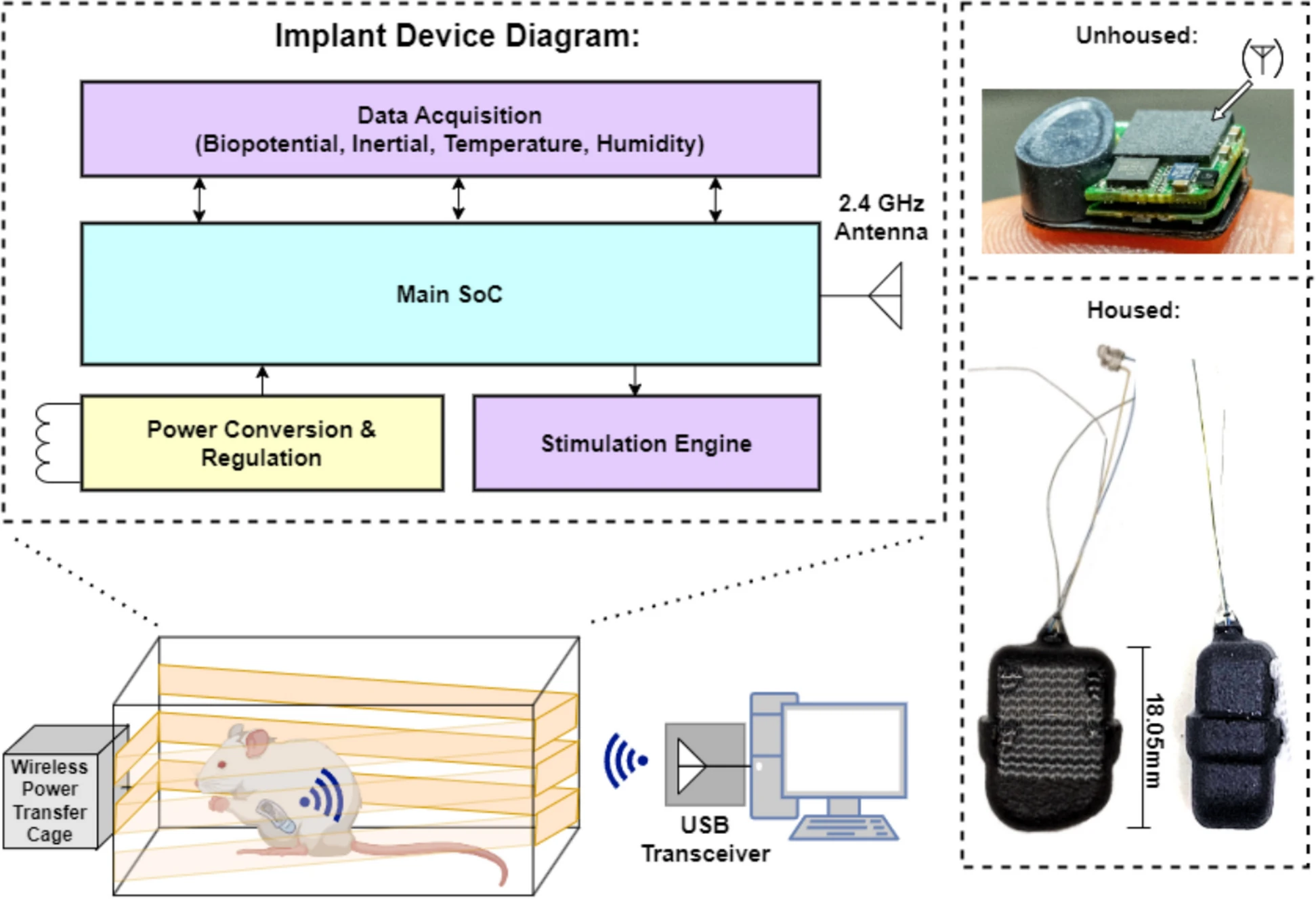
Neural recordings need sampling rates and resolution comparable to high-quality audio, streamed through tissue from an implant with a tiny power budget and an inefficient antenna. Bluetooth Low Energy is mature, but its throughput and robustness fall short under weak or noisy signal conditions.
Our approach
The Neural Real-Time Telemetry Protocol (NRTP): fixed-length packets, immediate acknowledgments, bounded retransmissions and a single radio channel, running on commercial 2.4 GHz hardware without custom chips.
NRTP kept zero data loss down to −75 dBm
Using identical hardware for both protocols, we swept received signal strength and compared throughput, data loss and current draw. NRTP sustained zero data loss down to −75 dBm, while Bluetooth Low Energy degraded below −55 dBm under interference, because its retries are deferred.
The link-margin advantage, up to about 23 dB at first loss and 11 dB at 0.5% loss, corresponds to roughly 3.2 times the range in air, about 2.5 cm more implant depth in tissue, or a lower transmit power for the same performance.
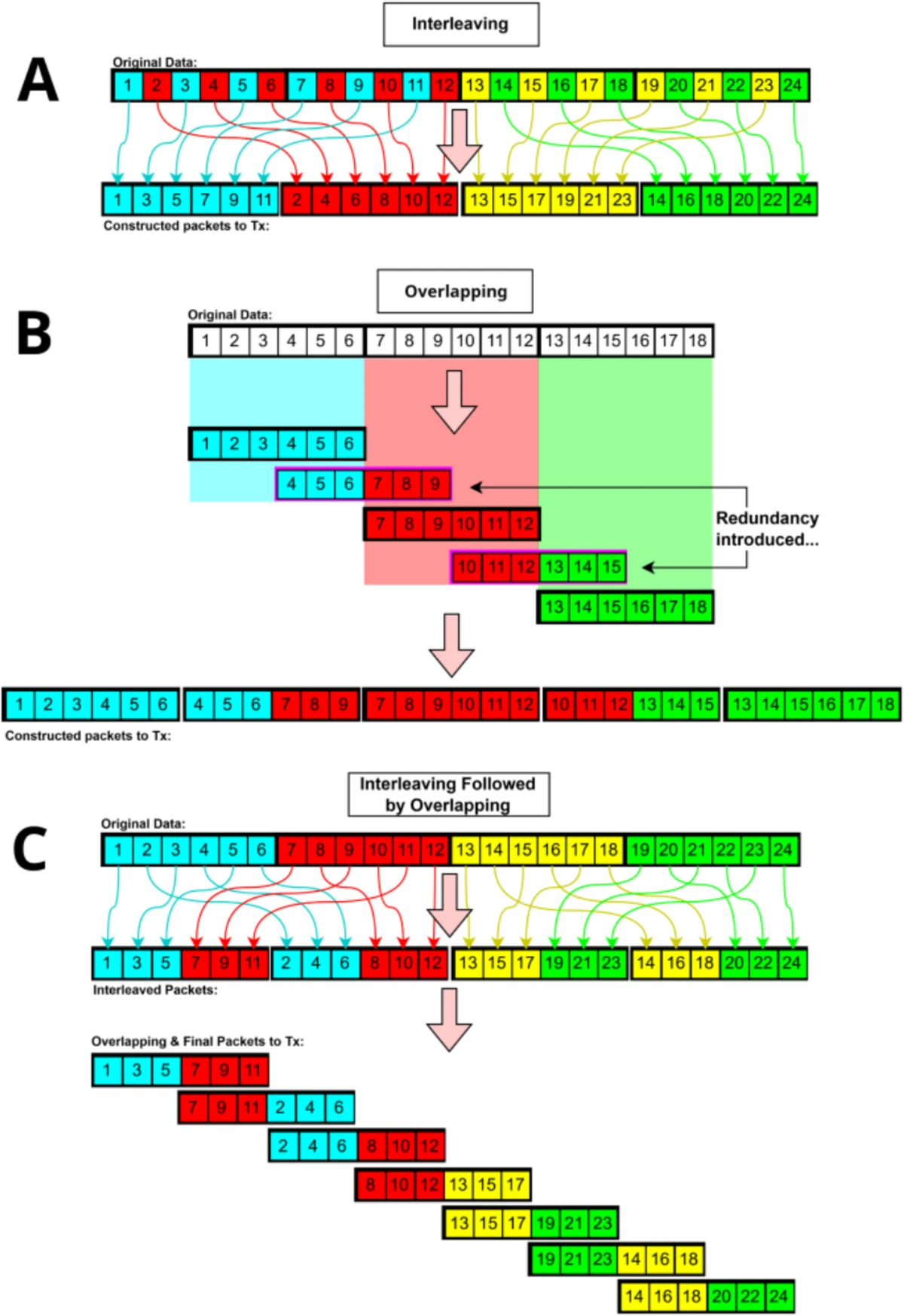
Interleaving turns lost packets into brief half-rate segments, not gaps
Splitting samples across alternating packets means a lost packet lowers the sampling rate briefly instead of leaving a gap in the recording. Overlapping data between packets improved robustness further, but required double the packet rate, which drew too much power for an implant.
The link is deliberately lopsided: our patent application describes configuring the implant to spend more than 90% of its airtime transmitting, because data flow mostly from the animal to the computer.